Enhancing Digital Interfaces with Blue Flat UI UX Elements
In the rapidly evolving landscape of digital product design, the visual language used to communicate functionality is just as critical as the code that powers it. Among the myriad of design trends that have emerged over the last decade, flat design has established itself not merely as a fleeting aesthetic, but as a foundational standard for modern user interface (UI) and user experience (UX) development. Specifically, Blue Flat UI UX Elements have become a cornerstone resource for designers seeking to create interfaces that are both visually appealing and highly functional. The color blue, often associated with trust, stability, and clarity, pairs exceptionally well with the clean lines and minimalistic approach of flat design, resulting in digital experiences that are intuitive and engaging.
The Strategic Value of Minimalist Design Assets
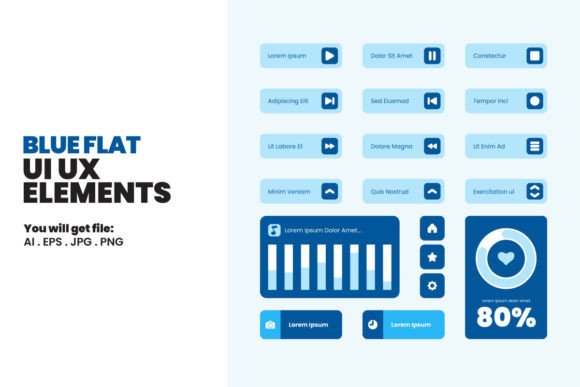
Designers and developers often face the challenge of balancing aesthetic innovation with production efficiency. Creating high-quality interface elements from scratch for every project is time-consuming and can lead to inconsistencies across a product suite. This is where curated asset packs, such as those containing Blue Flat UI UX Elements, offer significant strategic value. These resources provide a library of pre-designed components—buttons, icons, input fields, navigation bars, and toggles—that adhere to a cohesive visual style. By utilizing these ready-to-use assets, teams can accelerate their workflow, ensuring that the initial phases of prototyping and development are streamlined without sacrificing quality.
The elegance of minimal design lies in its ability to reduce cognitive load for the user. When an interface is cluttered with unnecessary shadows, gradients, or textures, users must work harder to distinguish interactive elements from static content. Flat design strips away these decorative excesses, focusing instead on typography, color, and spacing to guide user attention. A well-curated set of blue-themed elements leverages the psychological impact of the color to highlight primary actions, such as "Submit" or "Download," while maintaining a serene and professional overall atmosphere. This approach is particularly effective in enterprise software, financial applications, and healthcare platforms where clarity and trust are paramount.
Technical Specifications and Versatility
For professional designers, the utility of any digital asset is heavily dependent on its technical flexibility and compatibility with industry-standard software. High-quality design packs are engineered to meet rigorous specifications, ensuring they can be seamlessly integrated into various workflows. A premium collection of Blue Flat UI UX Elements typically includes a comprehensive suite of file formats to accommodate different stages of the design process.
- AI - Adobe Illustrator file: The source files are usually created in Adobe Illustrator, allowing for infinite scalability without loss of quality. This vector-based format is essential for designers who need to resize elements for different screen densities, from mobile devices to large desktop monitors.
- EPS: Encapsulated PostScript files ensure compatibility with a wider range of vector editing software, making the assets accessible to professionals who may not use the Adobe ecosystem exclusively.
- Corel Draw Compatibility: The EPS and AI files can be opened and edited using Corel Draw, providing flexibility for designers working in alternative professional environments.
- High Resolution JPG File: For quick previews, presentations, or web-based mockups where editing is not required, high-resolution raster images provide a clear view of the design intent.
- Transparent PNG files: These are crucial for immediate implementation in web development or rapid prototyping tools, allowing elements to be placed over various backgrounds without visible borders or white spaces.
This multi-format approach ensures that the assets are Ready To Use right out of the box. Whether a designer is building a high-fidelity prototype in a dedicated UX tool or handing off assets to a development team, the availability of these formats removes friction from the handoff process. Furthermore, because the designs are Easy To Edit For Your Project, customization is straightforward. Colors can be adjusted to match specific brand guidelines, and shapes can be modified to suit unique functional requirements, all while maintaining the integrity of the original elegant minimal design.
Applications Across Industries and Platforms
The versatility of blue flat UI components allows them to be applied across a broad spectrum of digital products. In the realm of e-commerce, for instance, clear and distinct call-to-action buttons are vital for conversion rates. A flat, blue button stands out against a white or light gray background, drawing the eye naturally to the purchase option without appearing aggressive. Similarly, in educational technology platforms, the calmness of blue helps create a focused learning environment, reducing visual stress for students engaged in long study sessions.
Mobile application development also benefits significantly from these elements. With limited screen real estate, efficiency in design is non-negotiable. Flat UI elements occupy less visual space than their skeuomorphic counterparts, allowing for more content to be displayed clearly. Icons designed in this style are easily recognizable at small sizes, ensuring that navigation menus remain intuitive regardless of the device form factor. The Made In Adobe Illustrator origin of these files guarantees that every curve and anchor point is optimized for crisp rendering on high-density displays, such as Retina screens.
Corporate dashboards and data visualization tools represent another key area of application. Here, the focus is on presenting complex information in an digestible format. Flat design principles help in creating clean charts, graphs, and data tables where the data itself takes center stage. The use of consistent blue tones can help categorize data sets, distinguishing between different metrics while maintaining a unified visual hierarchy. This consistency is crucial for user retention and ease of use, as it allows users to build a mental model of the interface quickly.
Considerations for Implementation and Customization
While pre-made assets offer immense convenience, successful implementation requires a thoughtful approach to customization. Blindly inserting Blue Flat UI UX Elements into a project without considering the broader context can result in a disjointed user experience. Designers must ensure that the shade of blue used in the assets aligns with the brand’s primary color palette. If the brand colors differ significantly, the ease of editing provided by the vector files becomes a critical feature. Adjusting the hue, saturation, and brightness of the elements ensures they feel native to the application rather than pasted on.
Accessibility is another crucial consideration. While blue is generally a safe and accessible color, designers must verify that the contrast ratios between the blue elements and their backgrounds meet Web Content Accessibility Guidelines (WCAG). Text placed on top of blue buttons or backgrounds must be legible for users with visual impairments. The simplicity of flat design aids in this regard, as it encourages high-contrast pairings, but vigilance is still required. Additionally, interactive states—such as hover, active, and disabled states—should be considered. Although a static asset pack provides the base design, designers must extend these styles to create dynamic feedback mechanisms that inform users of their actions.
The Importance of Intellectual Property and Licensing
When utilizing digital assets, understanding the licensing terms is essential for ethical and legal compliance. It is important to note that when you acquire a pack of Blue Flat UI UX Elements, you are purchasing a license to use these files in your projects, not ownership of the intellectual property itself. NOTE This is a DIGITAL download and NO physical items will be shipped. This distinction is vital for managing expectations regarding delivery and inventory.
Furthermore, the integrity of the design community relies on respecting copyright. The ACTUAL FILES may NOT be shared or resold in any form. This restriction ensures that the creators of these high-quality resources are compensated for their work and encourages the continued production of innovative design tools. Users are free to incorporate the elements into end-products, such as websites, mobile apps, or printed materials, but they cannot redistribute the source files (AI, EPS, PNG, etc.) as standalone assets. This protects the value of the original work and maintains a fair marketplace for digital goods.
In conclusion, the integration of Blue Flat UI UX Elements into design workflows represents a smart investment in both efficiency and quality. By leveraging these Ready To Use and Easy To Edit resources, professionals can focus more on solving user problems and less on reinventing basic interface components. The combination of an elegant minimal design, versatile file formats, and the psychological benefits of the color blue creates a powerful toolkit for modern digital creation. As the demand for seamless, intuitive digital experiences continues to grow, such assets will remain indispensable for designers aiming to deliver polished, professional results.